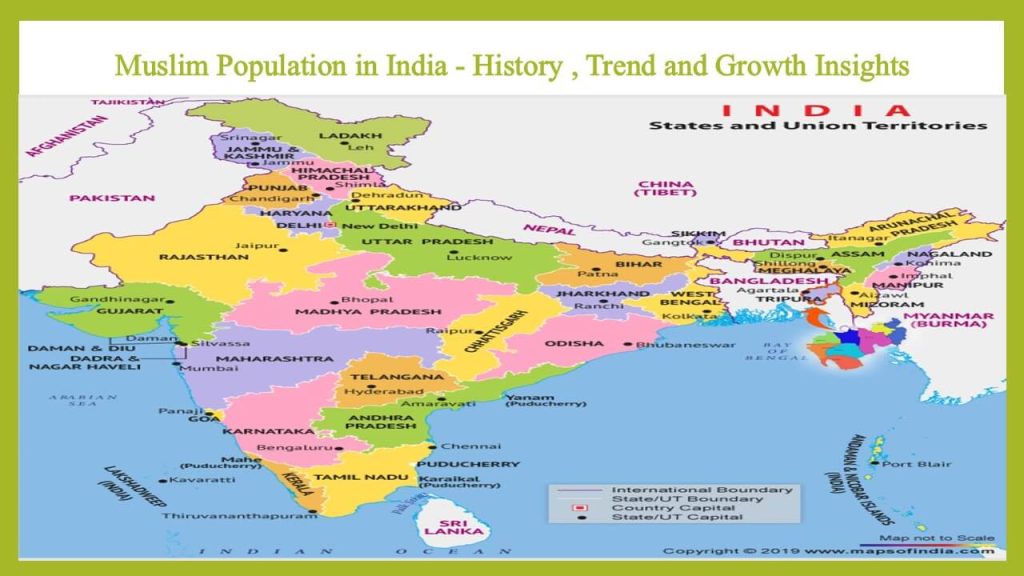
Key Highlights
- India has one of the largest Muslim populations in the world. They form a big part of the country’s different groups.
- The 2011 census data shows that the muslim population in India was 172.2 million. This number was 14.2% of the total population of india.
- The growth rate of the muslim community has been higher than the average in the country. However, it has been going down slowly for the past several years.
- Some indian states, like uttar pradesh and west bengal, have the most muslim residents.
- Islam in India has a long history. It goes back to the 7th century, when arab traders first came to india.
Introduction
Welcome to our look at the muslim population in India. This group is a key part of the country’s rich and mixed way of life. They have a long history in India. The muslim population has helped to make the country’s culture, art, and social feel what it is today. To understand india’s muslim population, it helps to see the facts on how many people there are, how their story grew, and what the future may look like. Does the history, number, and news about this community make you wonder about more? Let’s get into the details and see it together.
Table of Contents
Historical Overview of Muslims in India
The story of the muslim population in the indian subcontinent goes way back in time. It started more than a thousand years ago. At first, traders and people who spread beliefs came to the indian subcontinent. They settled along the coast. There was not any fighting in the beginning. Instead, the muslim population grew because these people arrived and lived there peacefully.
Over the years, the mughal empire became very large and strong in India. Many rulers from powerful dynasties took control, making big changes. This background helps us know why the community looks the way it does today and why it matters so much in India. In the next parts, you will read more about this long history.
Early Arrival and Spread of Islam Religion in India
The story of Islam in India starts in the 7th century. This happened before big Muslim empires came up in the north. Islam came to India because Arab traders set up sea trade routes here. The main place where they met people was the busy Malabar Coast in today’s Kerala.
These merchants came with both their goods and their beliefs. They lived and traded in peace with the people who were already there. Because of this, the first muslim communities started in India. One strong sign of this early time is the cheraman juma masjid in Kerala. People think it is one of the first mosques that was built in this country.
Trade and meeting new people helped Islam spread gently in the early days. This helped start the long and rich story of Islam in India. It shows that Islam has strong and varied roots in this place, which began before changes in politics.
Medieval Period and Muslim Dynasties
The medieval time was a big and important phase for the Indian subcontinent. During this time, many powerful Muslim dynasties came up. After the first Arab trips, Turkic and Afghan rulers started to set up sultanates. The most well-known one was the Delhi Sultanate. It ruled over a large part of northern India for more than three hundred years.
These dynasties brought in new ways to govern and new laws. They changed the way the political world worked in a big way. The rulers supported art, building work, and books, mixing ideas from Persian, Central Asian, and Indian cultures. During this time, people built great forts, tombs, and cities.
The rule of these Muslim dynasties in the medieval period helped grow the muslim population in the Indian subcontinent. Their power did not just change who was in charge. It also changed the daily life and culture of the people in these areas. This influence lasted for many years.
Mughal Era and its Influence on Indian Muslim Religion
The Mughal Empire began in the 16th century and was an important time in India’s history. This empire had a big effect on the cultural and religious mix of the country. The mughal empire brought much of the land together under strong control. It became known for good leadership and a powerful army.
During the Mughal era, you could see a special mix of Indian and Islamic ways of life shape the culture. People know this time for the big and amazing buildings like the Taj Mahal, Red Fort, and Humayun’s Tomb. The look of these places comes from mixing Persian and Turkic touches with Indian styles. You could feel this same coming together of cultures in painting, music, and food from that time. The unique blend made then still shapes how people think about Indian culture today.
The Mughal Empire helped the muslim population grow and settle by giving them a safe and steady place to live. The rulers of the empire were Muslim, but the empire had many types of people from different backgrounds and religions. Today, people still talk about the Mughal Empire and its history.
Role in Social and Cultural Evolution
For many years, muslim communities have been a big part of indian society. They have lived with other groups. Because of this, ideas, ways of living, and habits have mixed together. This has helped make indian society what it is today. You can see this in the language people use, the food people eat, the clothes people wear, and how people act every day.
The arrival of new ideas, new laws, and schools from Muslim thinkers and rulers was important. Sufi saints helped a lot, too. They talked about love and care for others. They mixed different beliefs in a way that brought people together. Their words and acts helped many feel close to each other. This can be seen among people who were from different ways of life. Sufi saints helped people feel more like one group, and this made life better for everyone.
This long past of living together has shaped the way both Muslim communities and Indian society see themselves. People from many cultures help build the country’s social fabric, and what Muslim communities add is an important part of that.
Contributions of India Muslim People in Pre-Independence Era
In the years before India became independent, indian muslims were key in fighting against British rule. Many leaders from the community, poets, scholars, and regular people joined in the fight for a free India. They worked together with those from other faiths for the same goal. Some well-known names are Maulana Abul Kalam Azad, Khan Abdul Ghaffar Khan, and Ashfaqulla Khan. Their sacrifices be remembered today.
Muslim intellectuals and leaders did more than take part in political activism. They also played a big role in forming the idea of a modern, secular India. They wanted a place where all people, no matter their background, could have dignity and be equal. This belief later became a key part of the new country.
The Indian Constitution makes a promise to accept many different beliefs and cultures. It gives freedom of religion as one of the most important rights to people in the country. The work of leaders before India became independent helped make sure that, after British rule, India would be a secular nation. It is a country that respects and protects all its religious communities. This idea of freedom for everyone is a key part of the Indian Constitution.
Change in Muslim Population Since Independence
Since India became independent in 1947, there have been a lot of changes in how the people live and grow in the country. One big change is seen in the Muslim population. The size of the group, its growth rate, and how it spreads out in the country are not the same as before. You can see these changes by looking at census data, which is collected every ten years.
Looking at population growth helps us learn about social, economic, and health changes in the area. How has the population changed in the last 70 years? The next parts will look at the shifts in people, what causes them, and what the numbers say about how the community has moved forward since independence.
Census Data from 1951 to Present: No of Muslims in India
The first census took place in 1951, right after the time of partition. It showed that there were 35.4 million Muslims in India. This number was almost 9.8% of the total population at that time. It became an important starting point to watch how the muslim population changed in India after it became an independent country.
Census data shows that the muslim population has kept growing over the years. Both the number of people and the percentage of muslims in the total population have gone up with time. For example, in the year 2001, there were 138.2 million muslims. That was 13.4% of the total population. The last official census data from 2011 said there were 172.2 million muslims. This made up 14.2% of the total population.
These numbers show the story of population growth over the past sixty years. The total population has gone up by a lot in that time. Still, it is also important to look at how fast this growth is happening and why it is happening. People and experts have talked about these factors for years. The topic of population growth is often discussed and studied by many.
Significant Demographic Shifts Over the Decades
The number of Muslims is going up. A big part of this change is how fast the population is growing. The data shows that, even though the growth rate for the Muslim population used to be higher than the national average, it has been going down for some time. This is one of the most important demographic trends for the number of Muslims, population growth, and the overall population growth rate.
The growth rate for Muslims dropped from 32.9% during 1981 to 1991 to 29.5% between 1991 and 2001. It went down even more to 24.6% from 2001 to 2011. This slower growth rate is an important part of the change in the community. You can see the same thing happening with other religious groups in India, though it is happening at a different speed for each group.
This drop in the growth rate shows that the Muslim community is following the same demographic trends as the rest of India. Things like more schooling, good healthcare, and higher income play a big part. Families are getting smaller because of this, just like in other parts of the country.
Major Factors Influencing Growth Trends
Many things work together to change the population growth rate in any group. This is also true for India’s Muslims. Money matters, how much people learn, and seeing a doctor or nurse are the biggest reasons for these demographic trends. A main sign people talk about is the Total Fertility Rate (TFR).
In the past, Muslims in India had a higher fertility rate than other religious communities. But now, census data and research show that this difference is getting smaller. The fertility rate among Muslims is going down faster than the rate among Hindus in recent years. This shows that both groups are moving to having smaller families.
Key factors contributing to these changes include:
- Rising Female Education: There be more Muslim women who read and get higher education now. This makes big families less common. When the level of education goes up, the number of kids in these families goes down.
- Improved Healthcare: Better healthcare for mothers and children helps all families. This lowers infant deaths, so people do not feel the need to have many kids.
- Urbanization: A lot of people now move from small towns to big cities. This changes their way of living and how much money they have. So, they often choose to have smaller families.
Migration, Urbanization, and Socioeconomic Impacts
Internal migration and more people living in cities are changing where the muslim population lives in India. A lot of muslims have left villages and now live in big cities and towns. they move to get better jobs, more schooling, and easier access to things like hospitals and other services. This change helps muslim communities grow in cities. The number of muslims living in urban areas is now rising because of these moves.
Urbanization can have many effects on people and society. It often helps people get better jobs and move up in life. But there are also some big problems, like not enough houses for everyone and a lot of stress on things the city needs, like water, roads, and parks. Sometimes, people end up living in areas that are separate from each other. This can cause some groups to feel left out from both money and social life.
The way migrants join the city workforce is very important. A lot of them get jobs in the informal sector. They help local economies by working as artisans, traders, and service workers. Knowing how these migration patterns work and what they lead to can help plan cities better. It also helps make policies that include all people.
Indian Muslim Percentage and National Demographics
When you look at India, the hindu population makes up most of the people at 79.8%. The share of muslims in India is 14.2% based on the 2011 Census. This makes them the biggest minority group in the country. The hindu population and share of muslims together show how much religious diversity there is in India.
Knowing this percentage helps you see how big and important the Muslim community is in India. It also shows where this group stands next to other minorities, like Christians, Sikhs, or Buddhists. The next parts will share the numbers and talk about how Muslims are the second largest religious group in the country.
Breakdown of Indian Population by Major Religions
The biggest way to find out how many people are in each religious group in India is the Census of India. This census happens every ten years, and it is done by the Office of the Registrar General and Census Commissioner. They use it to show the population of India in detail. The census divides the numbers by religion, state, age, and more.
The 2011 Census gives us the latest official numbers on the total population by faith. These numbers show that India is a country with many different religions, where people from different faiths live together. This data is important for the government, making policies, and research in schools.
Here is a look at the main religious communities listed in the 2011 Census:
- Hindus: 966.3 million (79.8%)
- Muslims: 172.2 million (14.2%)
- Christians: 27.8 million (2.3%)
- Sikhs: 20.8 million (1.7%)
- Buddhists: 8.4 million (0.7%)
- Jains: 4.5 million (0.4%)
Islam as the Second Largest Religion in India
Yes, Islam is the second biggest religion in India when you look at the people living there. The 2011 Census says there are more than 172 million people in the muslim community. It comes after the Hindu majority. This means India has the third largest muslim population in the world. Only Indonesia and Pakistan have more muslim population than India.
This fact shows how important Islam and muslim communities are in India. They are not just a small group. They make up a big part of the people in the country. You can find muslim communities in every state and union territory. Because of their large numbers, they have a big role in the country’s politics, social life, and culture.
Islam is the second most followed religion in India. This shows how the country brings together many different religious communities. India is not a Muslim majority country. Even then, a large number of Muslims live here together with people who follow other faiths. People in India have lived like this for many years side by side, sharing life and traditions.
Indian Muslim Religion: Distribution Across Communities
The muslim population in India is not all the same. There be a lot of differences within this group. You will find that religious diversity shows up in many ways like schools of thought, cultural practices, languages, and backgrounds. In fact, muslim communities are as mixed and varied as the indian society.
Most Indian Muslims are Sunni Muslims. They follow the Hanafi school. But there is also a big group of Shia Muslims, especially in places like Lucknow, Hyderabad, and areas in Jammu & Kashmir. Other than the main Sunni and Shia groups, there are many other traditions and ways of practice among indian muslims.
These groups have their own communities, like the Bohras and Khojas found in the west part of India. There are also many who belong to different Sufi orders. These orders have a long past and have shaped a lot of the culture across the country. This mix of people inside the Indian Muslim group gives, in its own way, more depth and color to the Indian Muslim identity. It shows how rich and lively these communities can be.
Comparisons with Other Minority Groups in India
When you look at india’s muslim population and other religious groups, you can see the scale is huge. Muslims make up about 14.2% of the total population. That makes them the biggest minority in india. Christians come next at 2.3%, and Sikhs make up 1.7%. So, the muslim population is over six times bigger than the christian population.
The large number of people in the Muslim community makes it stand out from other religious minorities in India. Because there are so many, they get noticed more in political and social areas. Problems that affect Muslims often become something the whole country talks about, as the community is spread out through India.
All religious minorities have the same rights in the constitution. But, the problems and chances they have are not always the same. This is because their numbers, where they live, and how they live or work can be very different. This gives the Muslim community in India a different kind of experience from other south asian ethnic groups and other minorities.
Total Muslim in India According to Latest Available Data
To find out the number of Muslims in India now, it is important to not rely only on the last census data. The most recent census in 2011 said there were 172.2 million Muslims in India. It has been over ten years since then. That number is old, and things have changed a lot since that time. So, what do people say is the likely number now using updated census data?
We are waiting for the next official count, so we use estimates from national and global groups. These groups share new surveys and studies, which give a good idea of how many people live in India now. In the next parts, you will read about the number of muslims from these reports and newer predictions. This will help you see how many muslims there are in India today.
Official Census Reports and Estimates
The most trusted and complete way to know about India’s population is the census that the government of India does every ten years. The last one was in 2011. At that time, the census said the number of Muslims in India was 172.2 million.
This census data helps show how the population growth has changed over the years. If you look at the numbers from 2011 and compare them to older censuses like 2001, when the population was 138.2 million, you can see these changes clearly. Demographers and policymakers use this information to track how the growth rate moves with time. A main point from this report was that the country had a 24.6% growth rate between 2001 and 2011.
The 2021 census did not take place, but older records still guide all studies about how many people there are. Any number you see now is made by looking at the latest official data. People use usual growth patterns to guess how many people there might be each year after that.
Recent Surveys and Projections Post-2011
In times when new census data is not there, several groups use projections to tell us about the current Muslim population. The Pew Research Center is known around the world for this work and is respected as a fact tank. Many people use their information. The Pew Research Center bases its estimates on birth rates, death rates, and how people move from place to place. Because of this, their insights about the Muslim population are trusted and show us changes in how people live.
A report by Pew Research Center in 2015 said that the muslim population in India could be 311 million by 2050. They may make up about 18.4% of the total population. With these trends, people now estimate that in the 2020s, the muslim population in India is already over 200 million.
Domestically, groups like the Economic Advisory Council to the Prime Minister (EAC-PM) look at changes in religious numbers. They often use past census data to talk about trends. These are not official counts, but these new surveys and reports give us the best idea we have since 2011. They help cover what we do not get from the delayed census.
Evaluation of Data Sources and Reliability
When looking at data sources about people and groups, there is a clear order for how much you can trust them. Census data is seen as the best source out there. It comes from a huge, door-to-door count that tries to find every person. This makes it the most complete and most trusted set of census data you can get.
Projections made by groups like the Pew Research Center are a strong source of information. The models are built in a way that follows science, but the numbers are still best guesses. They depend on what people think will happen with demographic trends. They could change if the trends in the future do not be the same as past ones. People talk about these numbers often. You can read debates on them in places like the Indian Express. There’s a lot of talk about the findings from different sources.
Some surveys or studies can give helpful ideas, but they often use fewer people and may not cover everything. Because of this, even though predictions are good for seeing where things are going now, the official census still has the most complete and trusted data for detailed population numbers.
Key Terms and Definitions Regarding Muslim of India
To get a good idea of the muslim population in India, you need to know some basic terms. Many people who work with data, such as those who study muslim population, as well as policymakers and news reporters, often talk about these words when they talk about groups with different religious backgrounds. These terms tell us more about how muslim population and other religious groups change and grow.
Having a clear meaning for these words can stop people from getting confused. This makes it easier to have a better talk about things. When we are looking at growth rates or how much of the population we talk about, saying things in the right way matters. If you know what these words mean, you can read the data right. This helps people understand what they are looking at and talk about it better.
Here are a few essential definitions:
- Muslim Population: The muslim population is the total number of people in India who say they follow Islam.
- Share of Muslims: The share of muslims shows how much of the total population of India is muslim. For example, in 2011 the share of muslims was 14.2% of the population of India.
- Decadal Growth Rate: The growth rate is the change, in percent, in the population of a group over ten years. It is used to compare numbers from two population counts.
Muslim Population Distribution by State
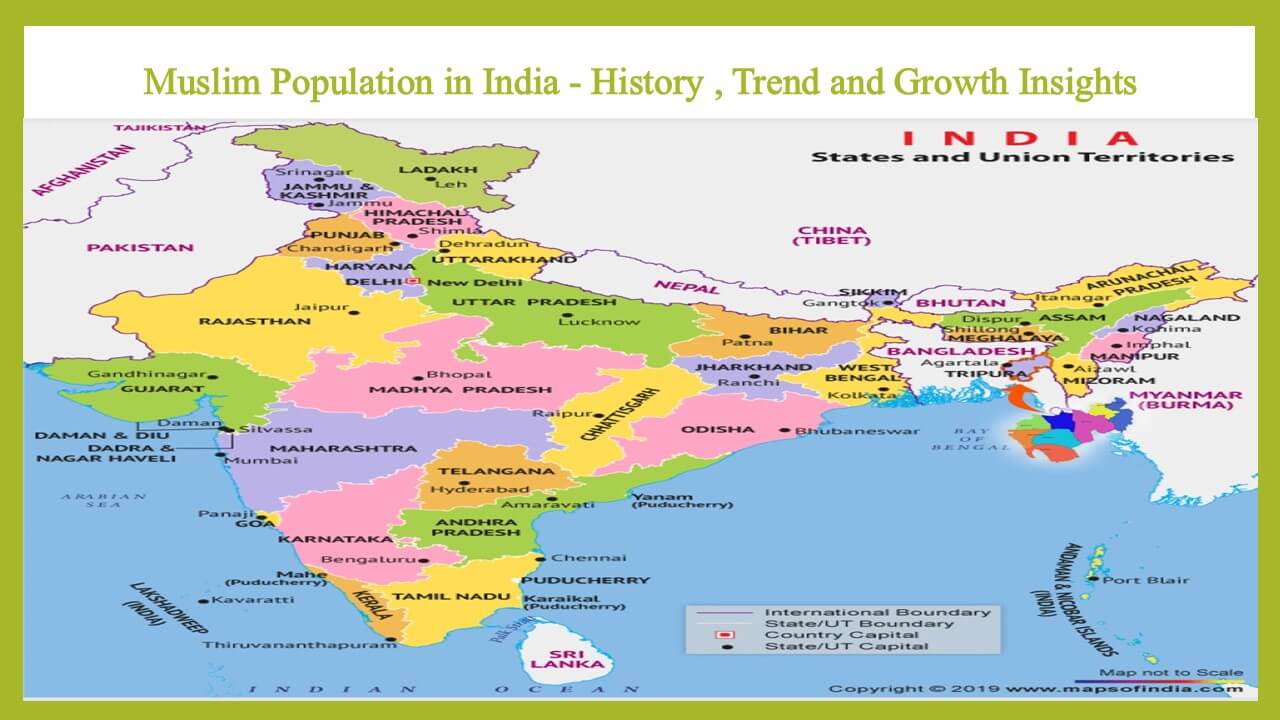
The muslim population in India is not spread the same way everywhere. It changes a lot in different Indian states and places. Some states have a big muslim population when you look at the total numbers. In some other states, the muslim population makes up a bigger part of the state’s total population.
This spread happened because of things in history, culture, and money over many years. Do you know which states have the most Muslims? The next parts will show data for each state. These will point out where the biggest groups are in the country. A table will also help you look at this information clearly.
States with Highest Muslim Population in India
Uttar Pradesh has the largest Muslim population in India. More than 38.4 million Muslims live in the state, as per the 2011 Census. The muslim population is one of the biggest groups in Uttar Pradesh. This makes Uttar Pradesh stand out when you look at states with the largest muslim population.
West Bengal comes next, with more than 24.6 million people in the Muslim population. Bihar also has many Muslims, close to 17.6 million. When you put the numbers from these three states together, you see that a big part of all the Muslims in India live here.
It is important to know the difference between the total number of people and the percentage of people in a group. Some states have the most people, but places like Jammu & Kashmir have a higher share of Muslim people in their population. Lakshadweep is also a Muslim-majority area. The large Muslim communities in Uttar Pradesh and West Bengal make these states important for Muslim culture and politics in India.
Regions with Moderate and Lower Muslim Populations
Many places in India do not have very large Muslim communities, but they are still an important part of life there. In the south, states like Tamil Nadu and Andhra Pradesh have Muslim communities that matter a lot in local history. The number of Muslims there is smaller compared to some other states, but these groups help shape the area’s social life.
For example, in Tamil Nadu, the muslim population was about 4.2 million and made up around 5.86% of the state in 2011. These people have their own ways of living and rich stories from the past. A lot of it goes back to old sea trade routes. The state of Madhya Pradesh, too, has a smaller muslim population in India compared to Tamil Nadu, but they have been living there for a long time. It is also known that their community in Madhya Pradesh is strong and has deep roots.
In some places, the number of people who practice Islam is much higher. The Lakshadweep Islands in the Arabian Sea are one such area. More than 96% of the people there are Muslim. This makes it the region with the most Muslims by percentage in the country. It shows how people live in different ways across India.
State-Wise Table: No of Muslims in India
To help you see how the muslim population is spread across indian states, you can look at this table. It shows the total population for some key states. You will find both the number of Muslim people and what share they have of the whole population in that state. The numbers are from the 2011 Census. The table makes it easy to compare and get an idea of the muslim population in each state.
This table helps you see where Muslim population in India lives. You can look at it and find that there are some states with a large number of people, but other states have a bigger share of Muslim population compared to how many total people live there. This happens because the history and the way people live in each part of India is different.
Here is a look at the Muslim population in several key states.
| State | Muslim Population (2011) | Percentage of State’s Population |
|---|---|---|
| Uttar Pradesh | 38,483,967 | 19.26% |
| West Bengal | 24,654,825 | 27.01% |
| Bihar | 17,557,809 | 16.87% |
| Maharashtra | 12,971,152 | 11.54% |
| Assam | 10,679,345 | 34.22% |
| Kerala | 8,873,472 | 26.56% |
| Jammu & Kashmir | 8,567,485 | 68.31% |
| Andhra Pradesh | 8,082,412 | 9.56% (Undivided) |
| Karnataka | 7,893,065 | 12.92% |
| Tamil Nadu | 4,229,479 | 5.86% |
Notable Districts with Significant Muslim Demographics
Looking closer at each state, some districts in India have a large Muslim population. This is true whether you look at the total number of Muslim people, or how many there are compared to the total population of the district. A lot of these districts are places where you find important culture and some economic activity for people in the community there.
This focus on the district level shows more than just numbers for the whole state. It points out places where there are a lot of people living close together. These areas often grow because of past settlements, people moving in or out, and local jobs. Knowing about the people in these places helps when you do planning and work in the community. This way, development can be done in a way that fits what the people there need.
Some areas with a lot of people from the Muslim population are:
- Murshidabad (West Bengal): In this district, more than 66% of the people are Muslim. It is one of the most well-known Muslim-majority areas in India.
- Rampur (Uttar Pradesh): This district is known for its history with Muslim nobility. More than half of the people here are Muslim.
- Kishanganj (Bihar): This area is in the northeast of Bihar, and almost 68% of the people here are Muslim.
These districts have a large muslim population. Murshidabad is located in west bengal, while Rampur is in uttar pradesh.
Urban and Rural Indian Muslim Population Trends
The muslim population in India is spread across both rural and city areas. Most indian muslims live in rural parts, just like many other people in the country. But there is a big shift happening now. More and more muslims are moving to live in cities. A large and growing number of the muslim population can now be found in urban places.
There is a clear gap between life in the city and life in the countryside. This gap affects things like how much money people make, what kind of education they get, and how they live day to day. Do Muslims who live in cities feel or act differently than those who live in small towns or villages? Next, we will look at how people live in both cities and villages. We will also talk about what it means when people move between these places.
Muslim Settlements in Indian Urban Centers
Urban areas across India have many Muslim communities. The move to big cities is usually because people want better jobs and education. It can also be for more chances to move up in life. New Delhi, Mumbai, Hyderabad, and Kolkata have a lot of Muslims living in them. These groups add a lot to the cities’ culture and jobs.
In many cities, there are areas where most Muslims live. For example, Old Delhi is a well-known place. It has a rich history and culture. You can find good food, busy markets, and special buildings there. A lot of the people are from families who have lived there for a long time. But some families have also come in more recently. These neighborhoods are home to both old and new groups of people.
Urbanization can give people new chances, but it also brings problems. Some of these problems are not enough good homes, streets and services that do not work well, and people living apart from each other. These issues can have an impact on people who live in these city areas. Still, these cities keep being lively places where business, culture, and new ideas grow for the Muslim community.
Distribution Patterns in Rural Areas
A large part of India’s Muslim population lives in rural parts of the country. Most Indians also live in these areas. The way this muslim population is spread out often comes from old farming habits and who owns the land. Many of these people are from groups called indigenous peoples who became Muslim many years ago.
Muslims in rural areas often work in farming, weaving, or making things by hand. They may live in villages where there are people from several groups, or sometimes a village might be mostly Muslim. The way people live together in these places is shaped by the old ways, and strong bonds in the community. Traditions often guide day-to-day life and how people interact with each other.
Population growth in rural areas is not always the same as it is in cities. The development of these places and what people earn can be quite different too. It is often harder to get education, healthcare, and jobs in rural areas, and this can be tough for Muslim communities living there. Still, their work and efforts in these places mean a lot to the rural economy.
Migration between Urban and Rural Zones
The movement of Muslims from country areas to cities keeps happening over time. This change to where people live affects many things in the way people live and work. A big reason for this move is money. A lot of people and families want to get better jobs and make more money, so they go to live in the city. Many of them leave behind farm work and instead find jobs in building, factories, or other city services.
This movement causes people, money, and ideas to move in a loop between the city and the village. People who move often send money back home to help their families. This money helps the whole village. When they return, they bring back new ways of thinking and new skills. This can help change things for the better in their village.
This change in where people live can also bring problems. Many who move find it hard to live well in city slums. They often do not get the help they need from social services. It is important to know how and why people move. This can help make life better for the groups they leave and for the new places they come to.
Impact on Local Economies and Cultures
Muslim communities, whether they live in big cities or small towns, shape the way local places grow and change. They help the area feel full of life, be more active, and make it interesting through the things they do for work and their strong traditions. You can see this impact in local markets, different kinds of shops, and cultural festivals happening all over India.
Muslims have a long history of being great at some types of jobs. They work as artisans and weavers. They also own shops and run businesses. Their work is important to how local people make money. The things they do shape the way people live. Food, music, and the words people use are often better because of them. This helps build a strong, rich feel for the area.
Here are some key impacts:
- Economic Roles: A lot of Muslims have jobs where they work for themselves as craftsmen. Many of them make things like cloth in Varanasi. Some work with leather in Kanpur, and others add fine stitching to items in Lucknow. These kinds of work help the local economy grow.
- Cultural Influence: Food like biryani and kebabs is now loved by people all across India. Urdu words and poetry have shaped the way people read books and watch Bollywood movies.
- Architectural Heritage: There are old mosques, grand tombs, and lively markets from the past when Muslims were in power. These places are some of the top sights for tourists and are central to the area’s culture.
Demographic Growth Patterns of India Muslim People
Talk about the muslim population in India often focuses on its population growth rate. People say that the growth rate of this community is higher than the country as a whole. But it is important to look at everything before making up our minds. The data shows the muslim population now has lower birth rates. The population growth rate is slowing down.
To see how this growth has changed over the years, and how it compares to other communities, we need to look at a few things. We have to check natural growth, the age structure, and what factors have an effect on these trends. This can help us get a better and clearer idea about the way the population of India’s Muslim people has changed. By understanding these points, we can also see how their growth is different from other groups.
Natural Growth Rate: Fertility and Birth Rates
The way the number of people grows in a country depends on the fertility rate and birth rate. This is what makes the growth rate go up or down. In India, the Total Fertility Rate, or TFR, means the average number of children a woman can be expected to have in her life. The fertility rate is important and is talked about a lot by the Muslim community in India.
Muslims have had more children compared to other religious groups in the past. But in recent years, the birth rate for Muslims has gone down a lot. This is the most important change you can see. If you look at the data from the National Family Health Survey (NFHS), you can see the drop is even bigger for Muslims than for other religious groups. For example, in NFHS-1 (1992-93) the birth rate for Muslims was 4.4 kids per woman. By NFHS-5 (2019-21) it went down to 2.3 kids per woman.
This big fall in birth rates shows there is a major change in the population. More women are going to school, people have better access to family planning, and life is better for many, and these are some of the reasons for this trend. The gap between the birth rates of Muslims and other groups is getting smaller. This shows that family planning is now becoming the norm for all communities in India.
Age Structure and Youthful Demographics
The age structure of the muslim population in India is different from other religious groups. There have been higher fertility rates in this community over time. So, the median age is younger than it is in other groups. A lot of muslim population is made up of young people. This is called a “youth bulge,” because there is a bigger number of people who are young when you look at the age groups.
A young population gives the country a chance to grow, as long as the young people are able to study, stay healthy, and find good jobs. Having many kids and teens in the workforce can help the economy, and bring new ideas. At the same time, it means there is more need for the state to make sure everyone gets education, healthcare, and job options.
The sex ratio is the number of females for every 1,000 males. Along with age structure, the sex ratio gives us another important way to look at the people in a group. The 2011 Census showed that the sex ratio among Muslims was 951. This was higher than the national average, which was 943. So, the Muslim community had a more balanced gender distribution than some other groups.
Factors Influencing Population Growth
The population growth rate in any group depends on many things. It does not come from religion alone. Social, economic, and culture all play a part. In India, the major reason for different growth rates across religious communities is usually the way their socioeconomic indicators line up.
For the Muslim community, experts who study population numbers have found several important reasons behind how the group has grown over time and why its growth has slowed down now. These reasons do not only impact Muslims, but also affect other groups in some way. It is important to understand these drivers. This helps get rid of wrong ideas and lets people have a better and more honest talk about the topic.
Here are some of the primary factors:
- Socioeconomic Status: A low income and less education is often linked to having more children in every community. When people’s income and education levels go up, the number of children they have usually goes down.
- Access to Healthcare: When mothers cannot reach healthcare and family planning services easily, more children are likely to be born.
- Levels of Female Literacy: How much women read and write is a very strong factor for how many children they have. When more women learn and stay in school, they often have fewer children, and they have them later in life.
Comparing Growth with Other Religious Communities
When you look at the population growth rate of the muslim population and compare it with the hindu population and other religious groups, you will see that the muslim population growth rate is higher. From 2001 to 2011, the muslim population grew by 24.6%. In the same time, the hindu population grew by 16.8%. This difference in growth rate has made people talk about it a lot.
A closer look shows that the growth rate for Muslims and Hindus is coming closer together. The growth rate for Muslims has been going down faster than for Hindus. From 1991-2001 to 2001-2011, the drop in the Muslim growth rate was about 5 percentage points. For Hindus, it was about 3 percentage points.
This shows that there is still a difference, but it is becoming smaller now. The demographic patterns of all the key religious groups in India are heading in the same way. The changes point to slower growth and more steadiness for the future. It seems that the main reasons for change are the socioeconomic things around people, not just their religious groups.
Socioeconomic Characteristics of Muslims of India
To really know about the muslim population in India, we have to look at more than numbers. It is important to see how they live, not just count how many people are there. We should think about things like how many go to school, how they find work, and the health of the people. The way they feel about their life and what they can do every day matters too. All of these things can change how the muslim population moves forward in India. It is clear that these things have a strong effect on the social and money side of their lives.
Many government reports and separate studies say that the Muslim community is, on average, behind the national average when it comes to development. This gap shows in things like literacy and how people live every day. The next sections will give a clear look at these things. It will show how the Muslim community is doing with reading and writing and what their lives are like now. All of this will help us understand their situation better.
Educational Attainment and Literacy Levels
Education and read-and-write skills show how much a group grows. Indian Muslims have faced big problems here. For many years, the group has not kept up with the rest of the country in read-and-write skill and joining higher schools.
The 2006 Sachar Committee Report made people across the country see this problem. It gave complete data about the issue of education in the Muslim community. The report showed that the literacy rate for Muslims was lower than the country’s average. It also said that more Muslim students drop out at primary, middle, and high school levels than other groups.
There has been some progress since the report came out. Even now, there are still differences that can be seen. The gap in reading and writing skills is getting smaller, especially for Muslim women. However, many face problems when it comes to getting good higher education and learning technical skills. Helping more people get a better education is seen as one of the most important steps for the community to move up and do well in their lives.
Workforce Participation and Economic Roles
Muslim communities in India do many different kinds of work. But, they often face some special problems when it comes to working. A lot of people from these communities are in the informal sector or run their own small businesses. Many of them are artisans, small shop owners, mechanics, or work for a daily wage.
This large number of people working in the unorganized sector makes them weak against changes in the economy. They also do not get social security benefits which come with regular jobs. The Sachar Committee Report said that Muslims do not have enough government jobs or jobs in formal private companies, when compared to how many Muslims live in the country.
Muslim communities play a big part in many local economies. You can see the impact they have in areas like textiles, handicrafts, and small-scale manufacturing. The work they do in these sectors matters a lot. To help them do even better, there needs to be more support for skill development, better chances to get credit, and easier ways to join the formal economy. All of this is important for muslim communities, so they can become stronger and feel more secure with their money.
Health Indicators and Living Standards
Health indicators and living standards show how well a group is doing. When you look at indian muslims, these things often tell us about their place in society. On the whole, the group tends to have lower health and does not enjoy the same living standards as the national average. But, this is not the same everywhere—there is a lot of difference from one state to another and between city and village areas.
Studies and reports from groups like the Economic Advisory Council have shown there are differences in things like infant deaths, mothers’ health, and how many people can use clean toilets or get fresh water to drink. A lot of these problems happen when people have less money, do not finish enough school, or live in places where there is not much help for them.
Over the years, things have got better. This happened because more people can now use public health programs. Now, many children get their shots on time, and people find it easier to go to a doctor. But, there are still some differences in how people get care. To help close this gap, there needs to be a focus on health programs that look at the needs of different groups. Making living conditions better for all people is also important.
Access to Social and Economic Opportunities
Access to social and economic chances is very important for people who want to do better in life. For many Indian Muslims, getting these chances can be hard. Some of the reasons are not having good education, not having enough money, and people thinking badly about them. These things make it tough for Indian Muslims to get good jobs in big companies, start their own work, or make their life better.
The way population growth affects jobs and the economy is not simple. When there is a large number of young people, it can be good for the country. But, this works only if they have the right skills and can find fair jobs. If there are not enough opportunities, more people may not have jobs. This can cause stress in the society.
Improving access needs more than one type of solution. The way to do this is to offer the right educational scholarships, run skill development programs, and make sure hiring is fair and open to all. Helping new entrepreneurs get credit is also important. When you empower the community, people can take on various jobs in the economy. This is good for their own growth, and it helps India move forward too.
Social and Cultural Identity of Indian Muslim Religion
The Indian Muslim religion has thea long and rich history. It is about 1,400 years old. Thea social anda culturala identity ofa Indiana Muslims is fulla ofa color anda lifea. Thisa identitya is nota justa onea thinga. Insteada, it is likea amosaic. Therea area differenta traditionsa, differenta languagesa, anda differenta waysa ofa livinga. All thesea cana changea froma onea regiona tothe anothera. Thea culturea ofa Indiana Muslimsa is built ona botha thea teachinga ofa Islam anda thea uniqua locala waya ofa beinga bea inthea Indiaa.
From special ways of worship and strong community ties to bright festivals and big steps in art, the cultural influence of Indian Muslims is clear for all to see. The sections below will talk about the many sides of this group. This social identity is a big part of India’s heritage, and you can’t think about India without it.
Religious Practices and Community Institutions
The religious life of muslim communities in India is based on key parts of Islam. People pray five times each day. They also fast during Ramadan and give charity, called zakat. The mosque, known as masjid, is very important for the community. It is not just for worship. It also brings everyone together for learning, social time, and helping each other.
Beyond the mosque, there are other important places for learning and faith. Madrasas are schools that teach about the religion. They can also offer modern lessons. Dargahs, which are shrines for Sufi saints, are spiritual spots visited by a lot of Muslims. Some non-Muslim people also go there. These places show a unique and mystical side of Islam in India.
These community institutions help keep religious traditions alive and also organize daily social life in muslim communities. The people there plan festivals, look after charity work, and give advice about faith. By doing all this, they make the connections between people in muslim communities stronger.
Festivals, Customs, and Traditions
The festivals, customs, and traditions of Indian Muslims show a nice mix of Islamic ways and Indian culture. The two most important festivals for them are Eid-ul-Fitr and Eid-ul-Adha. Eid-ul-Fitr comes after the month of Ramadan, when people have been fasting. Eid-ul-Adha is also known as the festival of sacrifice. On these special days, there are prayers. People enjoy big meals, share food, and give to charity. They also spend time with friends and family. These moments are truly special for indian muslims.
Beyond these big festivals, Muharram is marked in a serious way, mostly by Shia Muslims. They remember the death of Imam Hussein. People also celebrate the birth of Prophet Muhammad, known as Milad-un-Nabi. There are processions, and people gather together. These religious events be very important to the community.
Indian Muslim customs for birth, marriage, and death have their own feel. The people often add local customs from different states. This blending of customs from around the world and here in India is a big part of their culture. Because of this, the traditions are not only Islamic but also clearly Indian.
Important Contributions to Indian Art and Architecture
The work of indian muslims in art and building design is easy to see and lasts a long time in India. Many Indian cities have domes, minarets, and arches that show the unique style of Indo-Islamic buildings. This style was made over many years while several muslim dynasties ruled. Their mark can be seen in the way cities look even now.
The mughal empire was the peak of great building work in India. The rulers helped build many of the world’s most famous places and things to see. These buildings bring together Persian, Central Asian, and Indian art styles in a smooth way. This mixing of styles made something special. People all over the world now know and love it for how good it looks and how well it’s made.
Key contributions include:
- Architecture: The Taj Mahal in Agra stands out as a symbol of endless love. It is, for many, the most well-known spot. Other great places are the Qutub Minar and Humayun’s Tomb in Delhi, and the forts found in Agra and Lahore.
- Miniature Painting: The Mughal style of small painting is famous for its fine detail and bold colors. It shows their court, the beauty of nature, and events from history in a clear and lively way.
- Decorative Arts: Muslim makers showed great skill in calligraphy, tiles, weaving carpets, and the stone screens called jaali. The work done by them can be seen on many old buildings and places still today.
Language, Literature, and Media Influence
Indian Muslims have had a big impact on language and literature. One of the most important things they gave us is the Urdu language. It started in military camps and busy markets in North India. Urdu is a mix of Persian, Arabic, Turkish, and Khari Boli, a local Indian language. This language grew over time. Now, it is known for its rich poetry and simple prose.
Urdu literature is well-known, especially for its poetry like ghazals and nazms. Some of the biggest names in South Asia’s literary history are Ghalib, Mir, and Iqbal. Many people from different places and backgrounds still read and enjoy their work. The style and feel of Urdu poetry have been a big part of what makes Bollywood song lyrics special.
Muslims today are a big part of the media. They work as journalists, actors, directors, and people who write for movies and TV. They help shape stories in Indian films and shows. Many people in India know the stories they make and share. Muslims bring in new ideas and different views. By doing this, they add much to the way the country talks about its culture.
Contemporary Issues Related to Muslim Population in India
The muslim population in India deals with several issues today. Many people talk about these on TV and in the news. The problems are about how people live, get jobs, feel included, and are part of politics. A lot of talk happens about the population growth of muslim population and its growth rate. Some people have wrong ideas about the population growth rate of muslims, and this makes the conversations more difficult.
Taking care of these issues needs steps that are based on real facts. It is important to see both the problems and the chances to solve them. In the next parts, you will read about common views of people, how the community is shown in politics, what is being done to help people get along, and the way forward for the community.
Common Misconceptions and Public Perceptions
There are many wrong ideas and some bad views about the Muslim population in India. A lot of them are about Muslim population growth. These false ideas can make people feel worried. It also can cause tension among different groups. It is very important to talk about these things using real facts.
Many people think the muslim population is getting bigger very quickly to outnumber the hindu population. This view misses some key points. The growth rate of the muslim population is going down over time. S.Y. Quraishi, who used to be Chief Election Commissioner, points this out in his book “The Population Myth.” He says the difference between the hindu and muslim fertility rates is taking less space now. The numbers show the muslim population will not become more than the hindu population.
Here are some common mistaken ideas that are not true, as proven by data:
- Myth: Muslims do not practice family planning. Fact: Data from the National Family Health Survey shows that more Muslims now use family planning methods. This number has gone up in the last few years.
- Myth: The muslim population will soon be more than the hindu population. Fact: Projections show that the muslim population will be about 18–19% of the total population by 2050. It will not go over the size of the hindu population or the majority community.
- Myth: Large families happen because of religious beliefs. Fact: Experts say the main reasons for larger families are money problems and not enough education. Religion is not what drives family size the most.
Political Representation and Policy Considerations
Political representation plays a big role in giving power to a community in a democracy. For Indian Muslims, it is often hard to get enough seats in the government and in law-making groups. Many times, the amount of Muslim MPs and MLAs is less than their share of the whole population. This means that Indian Muslims do not get as much say as they should in running the country.
This gap in representation can change how rules and laws are made. The needs and worries of the community may not be spoken about enough where big choices are made. The growth of parties like Bharatiya Janata Party, which have had less Muslim members in the past, has brought more talk about the community not having enough say in politics.
Making fair rules that help with money and social problems in the community is important. The main thing is to look at the way people learn, teach new skills, and make sure everyone can get help from government plans. These steps aim to bring “Sabka Saath, Sabka Vikas” (Together with all, Development for all). The big idea is for all people, including Muslims, to get the good things that come from development.
Social Integration and Communal Harmony
Social integration and keeping peace in the community are very important for India. This is because people in India come from many different backgrounds. India has a long history where people from different groups live and work together. They share traditions and get along. At the same time, there have been times when some groups did not get along. Tension and violence between communities have made it hard to stay close and trust each other. This shows that while the country is strong in coming together, it still needs to work on keeping peace and unity for all.
Efforts to make people feel included in society involve talking with one another. People also try to celebrate what everyone shares in their culture. It is important to make sure that all people’s rights are protected. The supreme court and other courts have had a big part in keeping things fair and secular. They give important rulings to protect the rights of people in minority groups. This helps make sure that justice is there for everyone.
Building trust and understanding from the ground up be important to make people live together in peace. The civil society groups, community leaders, and people around us all help with this. They need to stop stories that split people apart. They also need to help everyone feel that we all belong together and have a future side by side.
Challenges and Opportunities Ahead
When we look to the future, we see that the Indian Muslim community is at an important turning point. There are big challenges to deal with, but there are also many good chances for progress. The key to growth and better times is how well the community and the country work together to solve problems and make the most of every new opening.
The main chance is in the young people. If they get a good education and the right skills, the community will grow and do well. The future depends on how much the youth learn and be strong in work and life. Their success leads to more jobs, better living, and good changes for all of us.
Here’s a summary of the road ahead:
- Challenges: Some of the main hurdles are educational and money problems. There is also the need to make sure everyone gets fair political voice. People in the community also struggle with negative images and stereotypes.
- Opportunities: A lot of young people in the community can be a good thing. Their skills with business and crafts can help drive economic growth, especially in today’s world.
- The Path Forward: We need to give more attention to schooling, building work skills, and making sure there is peace and fairness for all. This way, everyone can have a better future.
Conclusion
In the end, the Muslim population in India has grown over many years. The story of these people is made from years of history, changes, and culture. From the early days of Islam to now, a look at population growth, the Muslim population’s development, and their way of life gives us a good view of India as a whole. This community’s work, culture, and daily life show their big part in the country. If we learn more and talk about what is true, not what is guessed, we help make society better for all. If you feel this article helped you know more, please share it on social media. This can help more people know and understand.
Frequently Asked Questions
What is the current number of Muslims living in India?
The latest numbers show that there are about 200 million Muslims living in India. This is the biggest Muslim population outside countries where most people follow Islam. Muslims make up about 14% of India’s total population. These facts come from recent census data.
What percentage of India’s population follows Islam?
As of the 2011 census, Muslims made up about 14.2% of India’s population. This means Islam is one of the largest religions in the country. This group includes many different people and adds a lot to the culture of India. Recent numbers show there may be a small increase in their share since that time.
How has the demographic trend of Muslims in India changed over time?
The number of Muslims in India has changed a lot over time. This is because of different birth rates, people moving, and changes in the economy. For years, population growth has been shaped by new laws and changes in how people live. These things make the group mix in India very wide and complex.
Future Growth Insights and Projections for Indian Muslim Population
There is expected to be a steady rise in the Indian Muslim population over the next several years. The growth comes from things like more births and people moving to cities. By 2050, Muslims could be about 20% of the country’s total population. This will shape and change social and economic life in India for all people.